

Best Projector for Nursery Night Light: A Science-Based Guide to Safer Baby Sleep
Choosing a nursery night light projector is no longer just about aesthetics. Modern parents want devices that feel calming and align with what sleep and pediatric research say about light, circadian rhythms, and infant health. This guide breaks down the science and then applies it directly to galaxy projectors for your baby’s room.
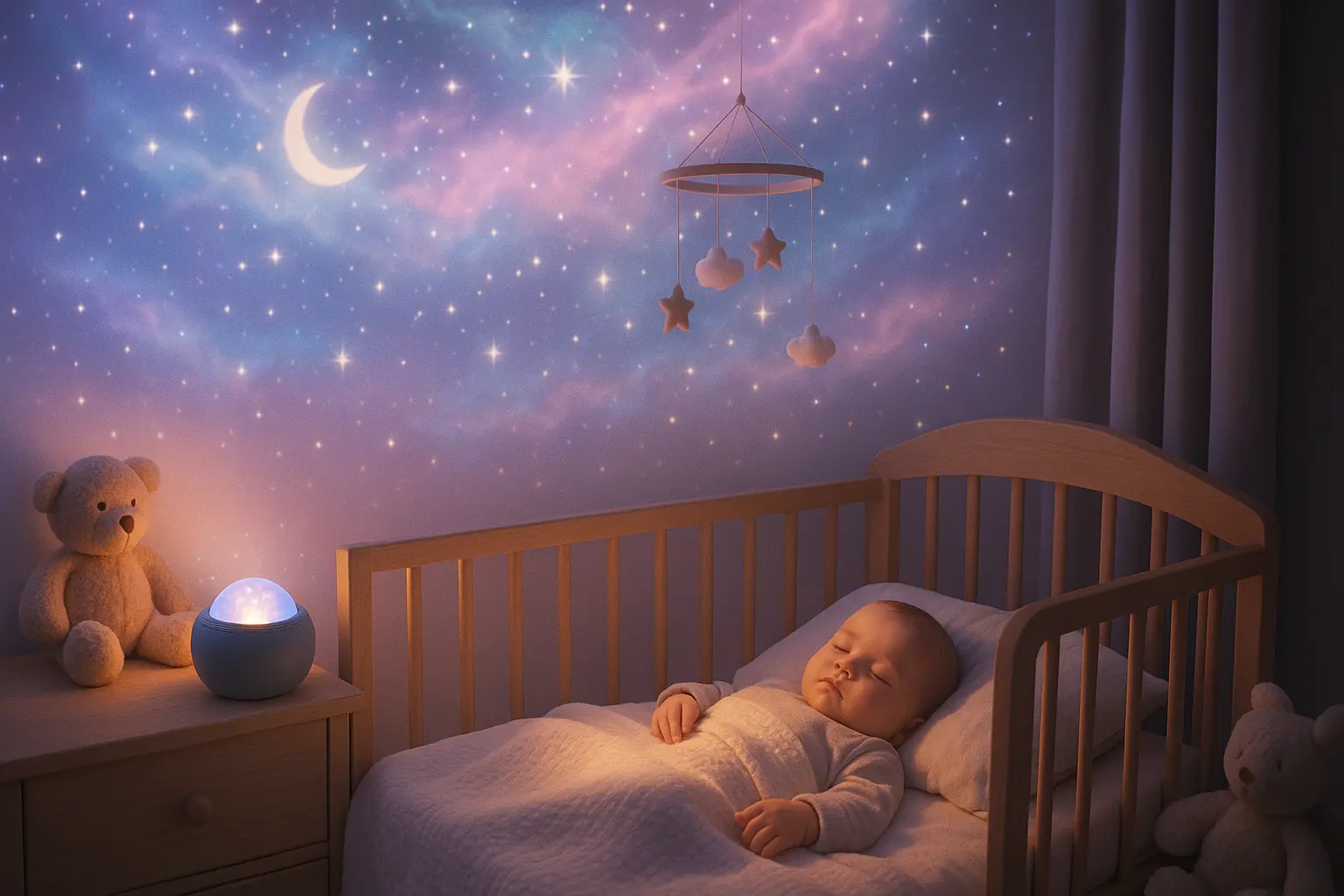
A soft galaxy projection can turn a dark nursery into a predictable, calming sleep environment for babies.
Why Nursery Night Light Projectors Matter for Infant Sleep
In the first months of life, a baby’s circadian rhythm gradually synchronizes with the outside world. Environmental light is one of the most powerful “time cues” for that process, alongside feeding schedules and social interaction. For an overview of light exposure and infant circadian rhythm, see the scoping review “The role of light exposure in infant circadian rhythm establishment” .
Actigraphic home studies have shown that infants with more daytime exposure to moderate light levels develop clearer day–night activity patterns, spending a greater proportion of night hours asleep. One such study is “Light is beneficial for infant circadian entrainment” , which tracked light and activity in young infants over seven days.
Night Lights, Myopia, and Melatonin: What Does Research Actually Say?
Early “night light causes myopia” headlines—and what later studies found
In 1999, an observational study reported that children who slept in rooms with a night light or full room lighting before age two were more likely to be nearsighted later, compared with those who slept in full darkness. The original report is summarized in “Children who sleep with light on may damage their sight” .
Later work highlighted significant confounding—especially parental myopia—and found that low-level night lighting is unlikely to be a direct causal factor. A useful discussion appears in Emory University’s “Night-light no cause of myopia, study concludes” , which reviews follow-up evidence and expert commentary.
Evening light, melatonin, and delayed sleep timing
Bright, blue-rich evening light can suppress melatonin and delay the phase of the circadian clock, pushing sleep onset later. An example is “Evening Light Intensity and Phase Delay of the Circadian Clock in Early Childhood” , which linked higher evening light intensity with later circadian phase in young children.
A perspective piece, “The Long-Term Effects of Light Exposure on Establishment of Newborn Circadian Rhythm” , emphasizes that both excessive light at night and insufficient light during the day may have long-term consequences for visual and circadian development. This supports practical guidance: avoid strong, blue-rich light near bedtime and during the night; favor lower intensity, warm-colored light when illumination is needed.
What Neonatal ICU Chronobiology Teaches Us About Light–Dark Cycles
Many of the best data on light–dark cycles and infant outcomes come from neonatal intensive care unit research. Reviews of cycled light (about 12 hours light, 12 hours dark) versus constant bright or constant dim environments show potential benefits for growth and hospital stay, though evidence is still evolving. One accessible summary is “Cycled light in the intensive care unit for preterm and low birth weight infants” .
A 2021 review, “Beginning to See the Light” , highlights that predictable day–night differences in light are considered beneficial for developing circadian systems, even in complex clinical settings. A more recent systematic review of chronobiology in neonatal care units also reinforces the importance of structured light–dark patterns.
How to Choose a Science-Aligned Nursery Night Light Projector
Translating research into buying criteria turns nursery projectors from cute accessories into tools for managing light exposure. Good devices help parents apply evidence-based principles without needing to read every journal article.
| Principle from research | What it means for a nursery projector |
|---|---|
| Daytime light supports circadian entrainment. | Use natural daylight or room lighting during the day. Keep the projector as a pre‑sleep or nighttime-only tool rather than an all-day lamp. |
| Bright evening light can delay sleep phase. | Choose projectors with multiple dimming levels and use the lowest comfortable brightness in the evening and at night. |
| Blue-rich light suppresses melatonin more strongly. | Prefer warm colors (amber, red, soft yellow). Avoid intense blue or cool-white modes near bedtime and during nighttime feeds. |
| Cycled light can support better development than constant bright light. | Use built-in timers so the projector turns off after 1–2 hours, allowing the rest of the night to be mostly dark. |
| Safety includes avoiding direct high-intensity beams. | Position projectors high and out of reach, directing light toward the ceiling or walls instead of into the baby’s eyes. |
From an evidence-informed standpoint, the ideal nursery projector is dimmable, offers warm-color modes, includes an automatic shutoff timer, uses safe LED or low-power sources, and can be placed so its beam is indirect.
Recommended Galaxy Projectors That Align With Sleep Science
With these principles in mind, two family-friendly options stand out: a UFO-style galaxy projector that fills the ceiling with softly moving nebulae, and the FlyLily Crescent Moon Galaxy Projector, which doubles as nursery decor. Both are best used as part of a structured bedtime routine, rather than constant overnight lighting.
UFO Galaxy Projector: Wide, Soft Nebula Ceiling
The UFO Galaxy Projector creates a large, cloud-like nebula and star field across the nursery ceiling, giving your baby a gentle visual focus as they settle for sleep. Multiple brightness levels let you shift from a more vivid galaxy during playtime to a very soft, low-intensity mode for pre-bed wind‑down.
- Dimmable nebula and stars to match different times of the evening.
- Warm, soothing color options that are better suited to night use than bright blue.
- Timer settings to automatically turn off after your baby falls asleep, preserving a darker environment for the rest of the night.
Used in this way, the UFO Galaxy Projector supports the idea of cycled light: engaging but time‑limited evening exposure followed by darker nights.
View UFO Galaxy Projector
FlyLily Crescent Moon Galaxy Projector: Decor Plus Sleep Tool
The FlyLily Crescent Moon Galaxy Projector combines a sculptural moon design with a layered galaxy projection, making it a visual centerpiece in a nursery even when turned off. When the lights are on, it can bathe the ceiling in a gentle starry wash that complements evidence-based sleep practices.
- Soft, ambient galaxy effects designed to avoid harsh hotspots or glaring beams.
- Mode options that can be tailored for story time, bedtime, or low‑light nighttime care, keeping night scenes calmer and dimmer.
- A stable base suitable for shelves or wall-mounted setups, making it easier to position the light indirectly and out of reach.
By pairing decorative appeal with practical features, the Crescent Moon Galaxy Projector encourages parents to use it intentionally: brighter, creative modes earlier in the evening, warm and minimal light near sleep, and then darkness after the timer ends.
Shop Crescent Moon Galaxy ProjectorA Sample Evidence-Informed Bedtime Routine Using a Nursery Projector
To make the most of any nursery projector, think in terms of a full 24‑hour cycle, not just the bedtime window. Research suggests babies do best when daytime is clearly brighter and more active, and nighttime becomes predictably darker and quieter.
Prioritize natural daylight and regular room lighting during the day. Keep the projector off so your baby’s internal clock associates bright, broad-spectrum light with daytime.
Dim the main lights and turn on the projector at a low brightness, using warmer colors like amber or soft red. Tell a quiet story or play gentle white noise while your baby looks at the slow galaxy movement.
Rely on the timer so the projector turns off within 1–2 hours. The rest of the night should stay as dark as is safely practical, supporting melatonin production and stable circadian rhythms.
If you need light, briefly switch on a very dim, warm mode or a separate low-level night light, avoiding bright blue or white light. Turn it off as soon as the task is done.
This routine does not replace medical advice. Parents should always adapt light and sleep strategies to their baby’s individual needs and consult pediatric professionals when sleep or visual concerns arise.
FAQ: Nursery Night Lights, Projectors, and Baby Sleep
Do babies need a night light or projector to sleep well?
Not all babies need a night light; some sleep well in total darkness. Night lights and projectors are most useful when parents need minimal light for nighttime care, or when older infants and toddlers begin to develop fear of the dark. The key is to use low-intensity, warm light and avoid overstimulation.
Is it safe for my baby to stare at a galaxy projector?
When positioned correctly so that light is indirect and dim, galaxy projectors can be used safely in nurseries. Avoid placing any projector directly above the crib or in line with your baby’s eyes, and ensure the device complies with safety standards and does not overheat.
How bright should a nursery projector be at night?
Guidance from sleep experts supports using the lowest brightness that still allows you to see what you need to do. Ideally, light should be dim, warm (amber, red, or soft yellow), and time‑limited via a timer, so the room becomes darker after your baby falls asleep.
Will using a projector all night harm my baby’s circadian rhythm?
Constant bright light at night can interfere with circadian development and melatonin secretion. To minimize risk, avoid leaving any projector on at high brightness throughout the night, and instead rely on short, dim exposure with an automatic shutoff.
External Links and References
- The role of light exposure in infant circadian rhythm establishment
- Light is beneficial for infant circadian entrainment
- The Long-Term Effects of Light Exposure on Establishment of Newborn Circadian Rhythm
- Cycled light in the intensive care unit for preterm and low birth weight infants
- Beginning to See the Light
- Baby Night Lights Do's and Don'ts
- Tips and Recommendations for Baby Night Lights
All external links are provided for informational purposes only. This article respects intellectual property and does not reproduce copyrighted text from these sources.
About the Author
This guide was prepared by the FlyLily Editorial Team, with input from sleep science literature and practical nursery lighting experience. The team focuses on creating lighting products and content that help families align everyday routines with emerging research on infant sleep and circadian health.
For collaboration or media inquiries, please contact the editorial team through FlyLily’s contact page .


